

Most crypto casino reviews are fiction. They are written by people who have never connected a wallet, never placed a bet, and certainly never tried to withdraw winnings during a network congestion spike.
We operate differently.
Our reviews are built on a strict Proof-of-Test Protocol. We do not accept payments for higher ratings. We do not scrub negative feedback. If a casino blocks a withdrawal because we used a VPN, we publish the screenshot. If their “instant” payout takes four hours, we log the timestamp.
Here is exactly how we audit every platform listed on this site.
Phase 1: The Deposit Stress Test
Marketing materials lie. Blockchains don’t.
A casino might claim “instant deposits,” but the reality depends on their risk settings. Do they credit your account after 0 confirmations (instant) or do they wait for 3 confirmations?
As of December 2025, Bitcoin network congestion has pushed average confirmation times to over 80 minutes on bad days. A “3-confirmation” requirement means you could be waiting four hours to play.
What We Test:
- Confirmation Thresholds: We deposit BTC, ETH, and SOL. We time exactly how long from “Transaction Sent” to “Funds Playable.”
- Minimums vs. Reality: We test the floor. If they say $5 minimum, we send $5. Many casinos quietly reject small deposits or trap them in a “pending” state until you send more. We flag this immediately.
- Chain Support: We verify native chain support. Sending USDT via ERC-20 (Ethereum) costs $5+. Sending it via TRC-20 (Tron) or SOL (Solana) costs pennies. If a casino only supports the expensive option, they lose points.
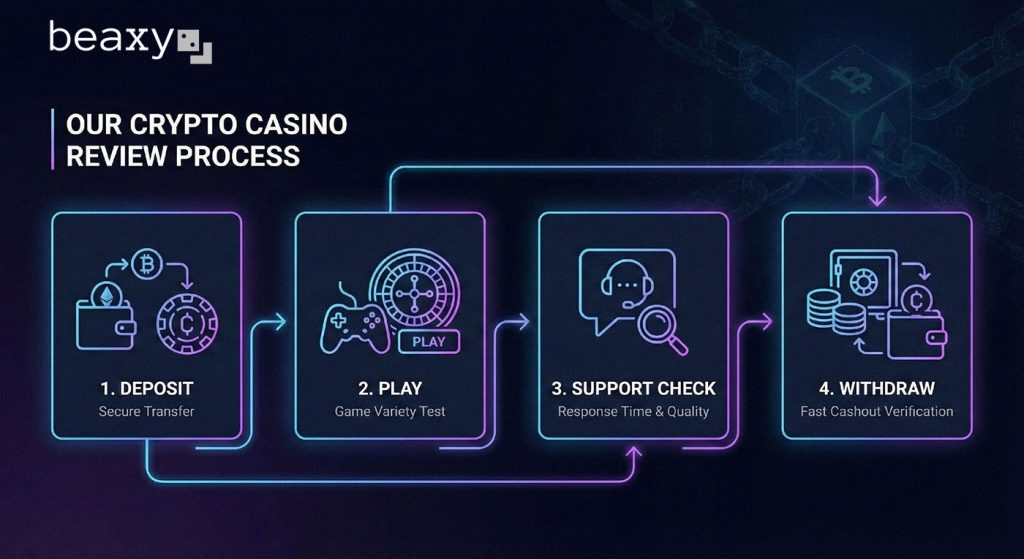
Phase 2: The Anonymity & KYC Audit
This is where most crypto gamblers get rugged.
Almost every crypto casino claims to be “No KYC” (Know Your Customer). But hidden in their Terms of Service is a clause that triggers identity verification under “suspicious activity.”
The “Tiered Trap” We intentionally trigger these clauses to see what happens. Our stress test includes:
- The Volume Trigger: We run cumulative withdrawals over $5,000. This is the industry-standard tripwire for mandatory ID verification.
- The IP Switch: We log in from different VPN locations (e.g., switching from Germany to Canada) mid-session. If this locks the account, the “anonymous” claim is false.
- The Withdrawal Stall: If they ask for ID, we measure how long they take to approve it. Is it an automated 5-minute check (SumSub) or a manual 48-hour delay designed to make you gamble your balance away?
If a casino demands your passport after you win—but didn’t care when you deposited—we label them a “KYC Trap” and downgrade their rating heavily. Read our rating of Best No KYC Casinos
Phase 3: Licensing & Security Verification
A JPEG is not a license.
Scam sites often paste a static image of a Curacao or Malta license in their footer. It looks real. It isn’t.
The Validator Check We verify regulatory standing by clicking the seal. It must redirect to the official validator domain (e.g., the Curacao Gaming Control Board’s verified URL).
- Curacao LOK Compliance: The regulatory framework changed in late 2025. Old “Master Licenses” are phasing out. We check if the operator has applied for the new direct permits under the National Ordinance on Games of Chance (LOK).
- Web-of-Trust Analysis: We check the operator’s history. Are they a rebranded version of a casino that exit-scammed in 2023? We trace corporate ownership structures to ensure you aren’t depositing with known bad actors.
- SSL & 2FA: We attempt to hack our own accounts. If a casino doesn’t offer 2FA (Two-Factor Authentication), it is unsafe. Period.
Phase 4: The “Provably Fair” Technical Audit
“Trust us, it’s random” doesn’t cut it.
True crypto games (Crash, Dice, Plinko) use Provably Fair algorithms. These allow you to cryptographically verify that the result was pre-determined before you hit “Bet” and wasn’t altered based on your wager size.
Our Verification Process:
- Seed Capture: Before betting, we copy the Server Seed Hash.
- The Play: We play a round of Crash or Dice.
- The Reveal: After the round, we reveal the unhashed Server Seed.
- The Hash Match: We run the revealed seed through a SHA-256 calculator. If the result doesn’t match the hash we captured in step 1, the game is rigged.
If a casino uses black-box slots from obscure providers without public RTP (Return to Player) data, we flag it as “Unverifiable.”
Phase 5: The Withdrawal Sprint
This is the final exam. A casino can have great games and bonuses, but if they hold your money, they are worthless.
We execute a withdrawal and start a stopwatch.
The Grading Scale:
- A-Grade: < 10 minutes (Automated hot wallet processing).
- B-Grade: < 4 hours (Manual batch processing).
- F-Grade: > 24 hours (Liquidity issues or stalling tactics).
The “Gas Fee” Scam We also check withdrawal fees. The Bitcoin network fee might be $15, but some casinos charge a flat $50 withdrawal fee to skim profit. Others charge $10 to withdraw USDT on Tron when the actual cost is $1. We penalize any casino charging more than a 10% markup on actual network costs.
How We Calculate the Rating
We don’t use arbitrary stars. Our 100-point score is weighted by what matters to traders and gamblers, not casual tourists.
| Category | Weight | Key Metric |
|---|---|---|
| Trust & Security | 30% | Valid license, cold storage, 2FA, owner history. |
| Payout Speed | 25% | Automated withdrawals, low friction, reasonable limits. |
| Bonuses & Terms | 20% | Wagering requirements (under 40x), no hidden max cashouts. |
| Game Fairness | 15% | Provably Fair support, RTP transparency, audit logs. |
| Support & UX | 10% | 24/7 live chat, mobile responsiveness, navigation. |
The “Rug Pull” Zero Any casino found to have confiscated winnings without cause, faked a license, or rigged a game receives a permanent 0/100 and is added to our Blacklist. We do not negotiate these removals.
Why This Matters
Crypto is adversarial. The code is law, but the interfaces are human.
You are trusting an offshore entity with your digital bearer assets. You cannot chargeback a Bitcoin transaction. You cannot sue a DAO. Your only protection is information.
That is what we provide. Verified, stress-tested, on-chain proof.
Check our Top Rated Crypto Casinos to see these scores in action.
Frequently Asked Questions
No. We monetize through affiliate links, which means we get a commission if you sign up. However, we only link to casinos that pass our audit. If a casino fails our safety checks, we blacklist it, regardless of how much they offer to pay.
We use a three-step process: 1) Sign up with a protonmail address. 2) Deposit via a privacy coin (like Monero) or a fresh wallet. 3) Withdraw a significant amount to see if it triggers a manual KYC review.
It is a game algorithm that uses cryptography (SHA-256 hashing) to prove the outcome was generated before you placed your bet. It ensures the casino cannot change the result in response to your wager size.
Delays usually mean one of three things: 1) They are manually checking your play for “bonus abuse.” 2) They don’t have enough liquidity in their hot wallet and need to move funds from cold storage. 3) They are stalling in hopes you will cancel the withdrawal and gamble the money back.